15 September 2011

River of Shadows/ Motion Studies Guest Review!

UK edition, published by Bloomsbury Publishing
As mentioned here some time ago, I've managed to manipulate my fellow bookclub members into generating some blog content.. That is to say, for our last meeting, they all kindly read Rebecca Solnit's book River of Shadows: Eadweard Muybridge and the Technological Wild West (also known in the UK as Motion Studies: Time, Space and Eadweard Muybridge), discussed said book, and one of their number has now gone above and beyond the call of duty to contribute some of his thoughts to PLATE!

US edition, published by Viking Adult
I'm really interested in the conflicts and connections between the written word and visual materials and I wanted to read Solnit's book, in particular, to see how she would incorporate art criticism with biography of Muybridge and cultural criticism. I had been really impressed by (for which, read, 'I fell in love with') her book A Field Guide To Getting Lost, after it was recommended to me by a colleague, and came to River of Shadows hoping for the same absorbing, lyrical, reading experience. I was also interested to see how the bookmakers would present the photographs in question.

I have to say, I was slightly disappointed by the book. I felt that, despite Solnit's in-depth knowledge of and passion for her subject, she struggled to weave together all of the historical and cultural strands in the book into a coherent whole (I'm inclined to agree with Carl, that the book's cultural analysis becomes too repetitive). As a fan of photography - and particularly the work of Muybridge - I was also hoping for more extended criticism of his work, and was only really satisfied by the section discussing his 'Yosemite' photographs in this respect. However, there were lots of things to like as well, and I will leave my excellent guest writer, Carl Fulbrook, to give you an idea what these were!

US edition, published by Penguin
Carl Fulbrook - I had few expectations before beginning River of Shadows; I hadn't heard of Eadweard Muybridge, I barely knew anything about the history of photography, and I (still) have only obscure notions of American history during Muybridge's. In frankness, these are not subjects I'm usually drawn to. But that's the beauty of a bookclub: you read things your friends want to read and discuss, and this usually yields a reading process of enjoyment and critical analysis in a more-or-less fruitful balance.

So I began Solnit's book knowing only that it was about one of the great innovators of photography and cinema. And it is in part a biography of Eadweard Muybridge. But the great strength of this book is that it is a lot more than biography; Solnit deftly traverses several usually discrete genres to develop a book that is at once the life story of Muybridge, a history of photographic technology and Silicon Valley, a cultural critique, and a portrait of an era in America's mid-West that is too often distorted by myth - including fascinating accounts of the so-called 'Indian Wars' and the General Strike. There's even a bit of sassy murder trial courtroom drama and, at the very end, a nostalgic personal postlude. In fact, one salient feature several people noted during our bookclub discussion was that Muybridge the character is almost the book's ellipsis. Something of his tenacity emerges through his achievements, but his photographic career was so varied (in the best sense) that it is hard to gain any definite impression of him through his work, and the brief flashes of personal drama (most obviously, murdering his wife's lover) occur like aberrations in a rather anaemic account of the externals of his life. No matter - Muybridge was evidently not remarkable for his charisma.

At her best, Solnit handles her subjects with a confidence that figures genre as irrelevant: it is quite often a very carefully woven narrative. I didn't find that this level was maintained throughout, however, and there were a several passages that seemed repetitive and didn't maintain my interest. I found The River of Shadows most compelling when it placed the concerns of Muybridge and his contemporaries in a larger historical frame. It was sobering and unsettling to realise how rapidly and dramatically technology have altered our relationship with both other people and with the physical world. By the twenty-first century almost every experience of our lives is structured and mediated by increasingly bureaucratic technological apparatuses. As Solnit points out, in a commentary inflected by Marxism, new technologies did not simply feed but created an appetite for a commodified representations of the world. By framing and freezing phenomena through human innovation, we lent ourselves the impression we were mastering the world; by converting this spirit of innovation into a means for profit, we commodified and alienated ourselves from it, although in doing so feverishly stoked the desire to innovate. Solnit is nostalgic in her commentary, although not wholly bleak - cinema is, after all, a very exciting and potentially reflective technology. The book ends in a very ambivalent key, and I'm grateful for it: it is rich food-for-rumination.


If you've read River of Shadows and have your own thoughts about the book that you'd like to share with PLATE readers, just drop me an e-mail at platethephotoblog@gmail.com - I will aim to publish a collection of new comments on the blog in a month or so. Even better, if you have photography-related book recommendations for me, the bookclub or other readers, send them over and I will incorporate these into another post!

11 September 2011

Ordering Principles: Taryn Simon

Installation view. Courtesy my smartphone..

The following article appears in the August-September 2011 issue of Hotshoe magazine - available from all good bookstores/ newsagents! Apologies for the lack of illustration - more to come when my computer stops crashing..


I first encountered Taryn Simon’s work in 2007, when An American Index of The Hidden and Unfamiliar - later nominated for the Deutsche Börse Photography Prize - was presented at The Photographers’ Gallery, London. Walking round that exhibition a friend declared that he enjoyed the work but found it too ‘magazine-y’; in other words, too editorial. While, admittedly, the images in that show – arresting, technically excellent photographs of unexpected subjects, including the art collection at C.I.A. headquarters and the results of exotic animal inbreeding at American ‘refuges’ -  did seem destined to appear in every Sunday supplement for months, implicit in this sort-of criticism of Simon’s work is the idea that her projects rely on human-interest storytelling, novelty value even, rather than technical and ideological rigour; that her use of the word ‘index’ to describe her photographic investigations is , at best, an ironic device and, at worst, lazy.

A
new exhibition at Tate Modern dispels these doubts. A Living Man Declared Dead And Other Chapters I-XIII is the result of four years (2008-11) research and travel, during which time Simon has compiled photographic, anecdotal and documentary evidence into a visual exploration of 18 ‘bloodlines’ and the internal and external forces that have shaped the collective destiny of these groups. In the meantime, of course, Simon has also exhibited Contraband (2009), for which she spent four days and nights at John F. Kennedy Airport, New York, continuously photographing all items seized before entering the country – a rigorous conceptual exploration of bureaucracy, illegality and the lives of dumb objects. A Living Man, however, simultaneously reaches further afield for its subject matter and delves deeper into themes that preoccupy Simon; the collision of physical, psychological and historical forces in determining our lives, the significance of those lives and the limits of any medium, photographic or otherwise, seeking to record or ‘index’ them.


Each ‘chapter’ of
A Living Man consists of three panels; the first (usually the largest) presents a grid of half-length portrait photographs, each taken in a deadpan style reminiscent of a mugshot or medical record photograph, ordered meticulously according to the age and position in the bloodline of each subject ; the second provides neatly ordered and scrupulously complete biographical captions to these images, in addition to textual information relating to a ‘post person’ or central figure in the line; and, in the third, ‘footnote’ panel, a more abstract collection of ephemera and photographic material is scattered across the ground, touching on contextual and peripheral matters. The sheer abundance of this material – bear in mind that each ‘chapter’ may deal with a bloodline of over 100 individuals – is overwhelming and it would be a hardened gallery-goer whose heart didn’t sink ever so slightly at the prospect of absorbing every scrap of research Simon has collated. Not only this, but the visual flair of An American Index is restrained here, with Simon self-consciously borrowing from scientific methodology to present work stripped of decorative or ‘editorial’ appeal. She has said herself that she became, at one point, ‘tired of photography’ and has begun to take photographs in a far more forensic vein.


The result, however, is complex and fascinating, if not always easy to assimilate. Even the grids of portraits display variety, personality and, very occasionally, direct evidence of family’s intersection with history. The most terrible case of this is in the chapter dealing with the
Srebrenica massacre in 1995 – six ‘portraits’ in this genealogy are composed of only the remains of the men who died in the atrocity.  Elsewhere, evidence of violence and trauma is affecting when juxtaposed with the apparently cool presentation of fact, as when Simon presents a grid of portraits showing a Tanzanian bloodline effected by albinism and, in the footnote panel, photographs of albino men, women and children affected by skin cancer. 


Of course there are questions to ask here: amid all this order, what organizing system generated Simon’s choice of her bloodlines?  It can feel, as you move into the fourth large room of this work, that you are on the look-out for the next ‘issue’ Simon is addressing, be it censorship and propaganda in China or, in the chapter from which this exhibition takes its title, a false declaration of death, used in order to cheat family members out of their land in rural India. Where these contextual ‘issues’ relate to racial identity, could you accuse Simon of restating the circumstance that conditions her subjects lives? 


These questions would be harder to dismiss were it not for the fact that Simon herself so insistently challenges any system used to document or organize human history, even her own. Her ‘chapters’ throw together straight photography, text and documentary evidence, including government records, newspapers and medical photography – all making competing claims to authenticity. Contradictions emerge between disparate sources – the portrait of a living man and the certificate that declares him dead – and occasionally they declare their own falsity, as with photographic ‘reconstructions’ in which members of the ‘Druze’ religious community (yet another subject) re-enact their deaths from past lives for Simon’s camera. The exhibition format itself stages a conflict between artistic and scientific approaches to documentation. In its use of ‘chapters’ and the juxtaposition of individual with genealogical, political and social external factors, the show is reminiscent of the novel form. At the same time, Simon’s deadpan portrait style recalls medical and scientific forms –
she even describes her grid-like arrangement as ‘like a periodic table’ and the exhibition itself as a kind of ‘experiment’ – as well as ethnographic portraiture.


There are blanks – absences – in
A Living Man and they draw attention to Taryn Simon’s continuing interest in what is invisible or hidden. Literally blank photographs take the place of those who cannot be photographed in the portrait series. There are formal ‘gaps’ in the work where we are encouraged to speculate about the meaning, the truth, of what we are seeing. It is these spaces that generate the mystery and complexity in an original and absorbing exhibition.


A Living Man Declared Dead and Other Chapters is showing at Tate Modern, Bankside, London from 25th May – 6th November 2011. Sunday to Thursday, 10.00–18.00; Friday and Saturday, 10.00–22.00; Entrance Free. A catalogue is available from Mack Books/Neue NationalGalerie, Berlin for £80.

17 August 2011

Better than your average holiday snaps


Hello my little blog-babies - this is a slightly shorter and less text-heavy post than usual, partly due to time pressures (team Hayward Publishing are hard at work on this at the moment) and also just because, y'know.. variety is the spice of life..

I am due to go on holiday at the end of this week and I'm not ashamed to say I am limping towards the finishing line. It's only four months since I last had a break but I'm as tired and run down as can be, so it's nice to take a moment, look at some great photographs and breathe a (vicarious) breath of fresh, Mediterranean air. The great photographs in question are by a young man named William Matthew Harvey, who also happens to work at Aperture Foundation - one of my favourite photobook publishers, and home of the very beautiful Aperture magazine.


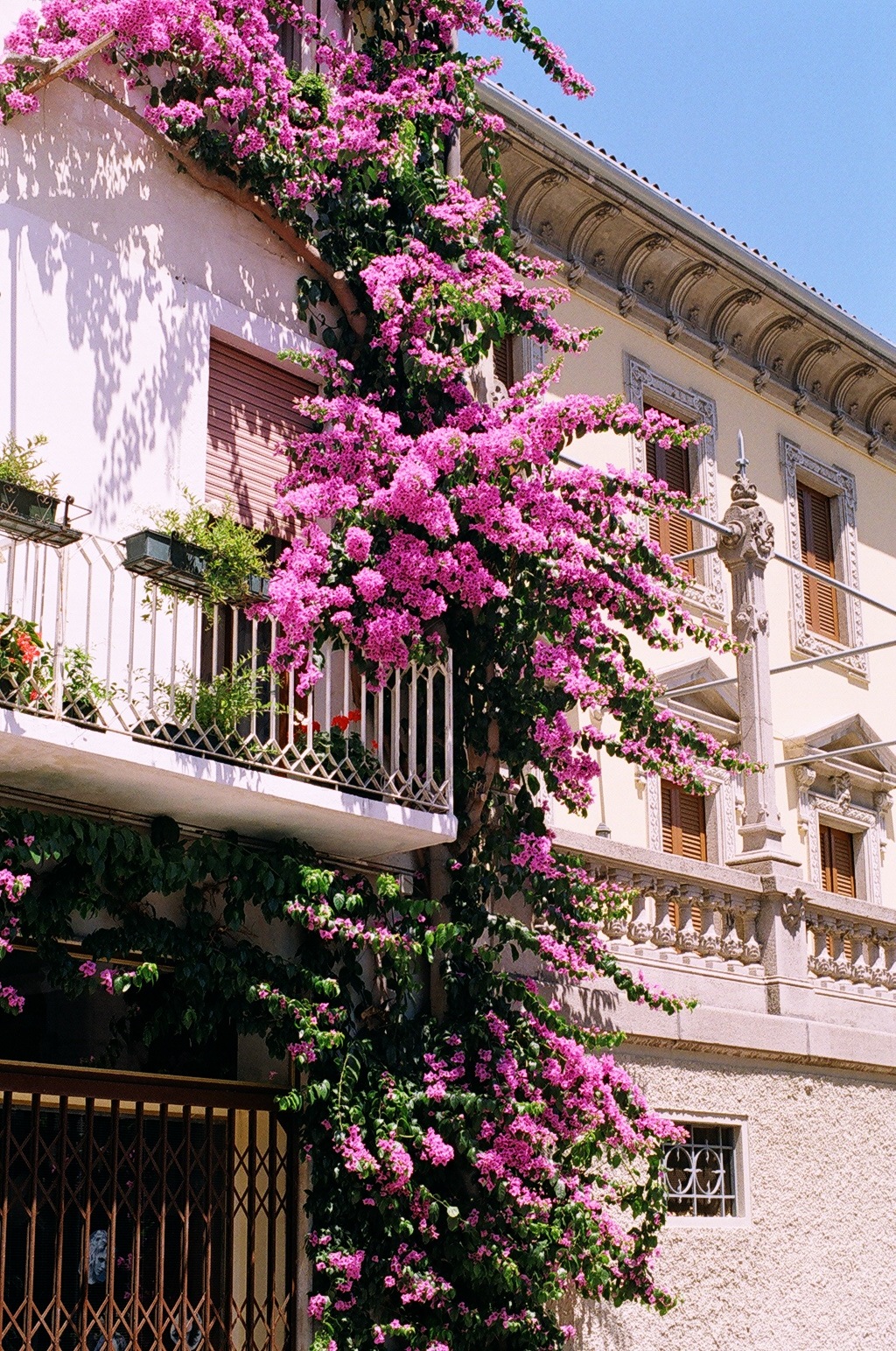
The photos were taken near Lake Garda, in Italy - as if the warm light and hazy atmosphere in some of the shots weren't enough to tip you off. Sun-burnished buildings, vivid flowers and foliage, and rocky terrain all give you a sense of the landscape and climate, but what I like best about these photos as a series is that you really get the send of someone wandering - taking their time to explore a new terrain and taking pictures whenever something appealing catches the eye. Apologies to Matt if I grossly misrepresent his process here!


Considering that these are, broadly speaking, photographs of landscape, it's interesting that the photographer doesn't use that format much - focussing instead on the edges of buildings or placing some complex feature of the scene, like the creeping plant above, in the centre of the, vertically-orientated, frame. The images are all the more intense for it, and the partial views presented preserve the sense of movement or 'wandering' that I mentioned above, even when the subjects are static.


The photo above is definitely one of my favourites in the set  - the way this building is framed, and it's broad, brightly-coloured 'facing' is emphasized, really throws your attention onto the light effect of the low evening sun. It's a sensory image, in that you are made to identify with the building, leaning into the last of the day's light. I also love the way those fine cables and the filaments of the aerial are arranged in the top of the space - situating the building in space in really delicate fashion.


The expanse of warm rock above has some of the same effect as that beautiful yellow house - it can really be felt outside the frame, and, as a subject, is reclaimed from the stock, holiday-scenery background by it's scale and presence. Some of the images above also remind me, dare I say it, of John Gossage's interest in the boundaries between different kinds of space, not least the natural and manmade worlds.

Anyway, a big thankyou to Mr Harvey for allowing me to put these images on my blog and jot down some of my thoughts on them. I will leave readers with the image that best represents my feelings this week.. The holiday scene, so near yet so distant, obscured by the dark, obfuscatory foliage of the workaday week... Am I being suitably melodramatic? See you all on the other side, when I will return refreshed and hopefully less prone to the excessive prose..


12 August 2011

Just when I thought..

Semi Submersible Rig, 2007

..I couldn’t love the Whitechapel Gallery more, they go and put on this summer’s exhibition - Thomas Struth: Photographs 1978-2010. Weirdly, my mood was set by looking at the exhibition catalogue, which I usually do after coming out of a show (I have lots of strange, nerdy exhibition rituals, mostly to do with a childish desire not to ‘spoil’ the surprise of the work before I see it..) While waiting for a friend to arrive at the gallery, I took a look at this publication (which isn’t obviously a catalogue as much as a trade-focussed ‘survey’ of the photographer) and loved it enough to splurge a precious £30 on it.

It’s a large-format paperback, in a wide, square size you wouldn’t expect in this binding. The design – by Fernando Gutierrez Studio - isn’t ‘shouty’, it’s pretty understated in fact, but there’s something about the treatment which is strikingly original. The cover image, for example, isn’t an obvious choice, but the hi-tech industrial colour-palette of Space Shuttle 1 Kennedy Space Center  is very beautiful and deliberately engaging.  Inside, the plates are beautifully printed on one paper stock, and four substantial essays are printed on another, with an illustrated ‘list of works’ section at the back. From the perspective of someone who does this stuff for a living (a geek), this book is pretty inspiring and definitely the best catalogue I have seen for a long time.

Something else that struck me about the show itself was the generosity of the photographer – he speaks in the exhibition film, at length, about his practice and his working process, in detail and in the context of his studio. Struth’s insights into his work and inspiration feel very intimate – they seemed to chime exactly with the experience I had standing in front of the photographs, which leads me to feel that Struth has a very exact and finely-tuned sense of what his photographs do and how they do it. His description of the Paradise series and its effects, for example, seemed disarmingly precise. Standing in front of these huge, colour prints – dense, apparently unstructured scenes of tropical vegetation – I feel drawn into the viewing experience, into an act of looking which retraces the steps of the photographs making.

Paradise 36, 2007

Struth talks a lot about the viewer and about looking – particularly with regard to these jungle scenes. With nothing to ‘interpret’ as such – a jungle is a jungle is a jungle – the viewer is thrown back onto themselves, onto an awareness of where they are standing, what they are looking at and how they are looking. The effect is generous, thought-provoking and meditative.

El Capitan, 1999
He also speaks intelligently and informatively about photography and what it can do in other contexts – about exposing social architectures, the simultaneity of different strands of existence in urban life (his cityscapes), about the sublime, the way his pictures work, and about the function of art – it is, he says, a reconciliation with the past and a way of thinking about how we will move forward into the future; a way of making sense of, and coping with, the present. This joins up completely with my experience of the show and the photographs, which face up to subjects such as the overwhelming complexity and strangeness of modern technology, the abundance of visual cultures and even how families look and relate to each other in ‘family portraits’. All of the subjects are treated with a sort of intense, investigative gaze that is reflected in the way you have to look at the photos – there are clues and visual allusions everywhere that help you to read the photographs for history, social context and personal resonance, and to think through them.

Milan cathedral, 1998

Lots of reviews of this show have mentioned the same aspects of the work – it’s scale, Struth’s interest in architecture and human responses to the awe-inspiring or sublime. Few mention how subtle and warm the photographs can be. It’s awe-inspiring to stand in front of a ceiling-height photograph of the façade of Milan Cathedral, but it’s also interesting to note how the photographer pulls focus into the foreground, to where ant-sized tourists mill around the cathedral entrance. When Struth’s gallery photographs are hung, at full-size, so that you are on a level with the crowd of spectators inspecting great works of art in institutional settings, these images become involving rather than alienating, and witty with it – you recognise yourself in the works and their subjects. That’s the feeling that stayed with me after leaving this exhibition – I’d been looking at photographs, but they’d been looking right back.

Thomas Struth: Photographs 1978-2010
is showing at Whitechapel Gallery, London from 6th July – 16th September 2011. Tuesday to Sunday, 11.00–18.00; Thursday, 11.00–21.00; Entrance, £9.50/£7.50 concessions. All photographs used in this post are courtesy Whitechapel Gallery, London, and copyright the artist, Thomas Struth.